

Do B2B customers really prefer calling to online ordering?
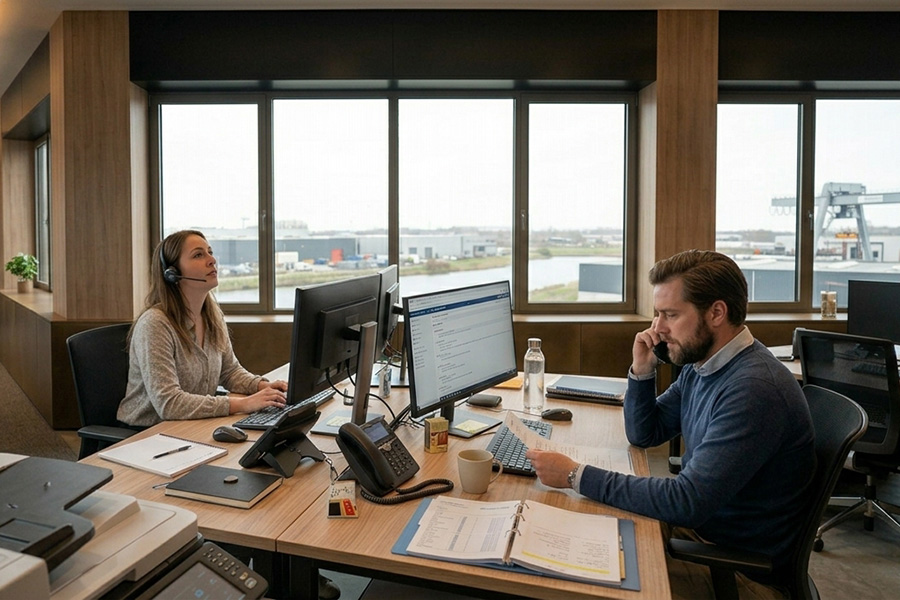
Almost every manufacturer and wholesaler makes this statement at some point: our customers aren't asking for a webshop, and they prefer human contact. Usually, this is presented as a single argument, even though they are two separate claims. There is no demand for it, and personal contact is the reason customers stay.
The first claim is testable. The second is often true, just not in the way it is intended.
The available research points in one direction. In August and September 2025, Gartner surveyed 646 B2B buyers: 67 percent say they prefer a purchasing journey without a sales representative. A year earlier, that figure was 61 percent. Sana Commerce, a competitor of ours, surveyed 750 buyers in six countries, including the Netherlands, for its 2025 B2B Buyer Report: 73 percent prefer to buy online, and 75 percent are considering switching suppliers for a better experience. The latter study comes from a party that sells B2B webshops itself, which is worth keeping in mind. The Gartner figures come from an independent analyst firm and point in the same direction.
Neither proves that your customers feel this way. It does, however, say something about where the average buyer is heading.
1. “They aren't asking for it” rarely means “they don't want it”
Customers ask their supplier for a price, a delivery date, and a solution when something goes wrong. No one asks for a customer portal, just as twenty years ago no one asked for an email address instead of a fax. Demand becomes visible through behavior.
Where you can spot it: the number of order emails that arrive after office hours or on weekends, the number of times per month someone asks to have an invoice or packing slip resent, and the number of calls that boil down to “has my order shipped yet?”
There is also a demographic shift at play. In that same Sana survey, 71 percent of B2B buyers are now millennials and Gen Z. This is the generation that handles its private purchases entirely online and brings that habit to work.
Furthermore, who you are actually hearing is shifting. Your account manager speaks with the business owner or the purchasing manager. The order is placed by the warehouse worker, the site foreman, or the technician. That second group is rarely asked anything, yet it is precisely that group that deals with the ordering process on a daily basis.
2. Contact and friction are not the same thing
Someone who calls to reorder eight familiar items is not maintaining a relationship. That is an administrative task with a voice attached to it, simply because there is no other way.
Moreover, that type of contact is not error-free. According to APQC benchmarks, manual order entry has an error rate of 1 to 3 percent, and 33 percent of buyers in the Sana study report order errors due to inaccurate data. A mistyped item number costs more goodwill than an order the customer placed themselves.
The question, therefore, is not how much contact there is, but which contact customers choose and which contact they endure. Advice on an application, a second opinion on a specification, a solution to a problem: that is what customers come back for. Providing item numbers is not part of that.
3. A webshop changes what the contact is about
In most internal sales departments, a large part of the day is spent on order entry and retyping orders into the ERP. Industry estimates put this at 20 to 40 percent of such a team's time, with about twelve minutes of processing per manual order. Do the math on your order volume from last month.
That work disappears as soon as orders come in directly. The employees do not disappear with it.
What replaces it determines whether the investment pays off: following up on outstanding quotes, calling customers who have started ordering less, helping with introductions to new accounts. Work that remains undone in most companies because the phone takes priority.
4. Sales gains access to information
A representative who visits without preparation asks how things are going. Someone who sees in advance that the customer's order frequency has been declining for two months, that there is a quote open since April, and that they have searched three times for a product group that was never previously supplied, has a different conversation.
That element is usually missing from the objection. Digital orders provide data on customer behavior that you never systematically collect with telephone order entry.
5. Personal contact doesn't scale, and the relationship often lives in one person's head
When a relationship relies entirely on a single account manager, all the knowledge resides there: which price agreements were made, why a customer prefers a specific version, what went wrong last year. If that person goes on leave, gets sick, or leaves the company, that knowledge disappears—and sometimes the customer follows.
A portal with order history, quotes, price agreements, and documents anchors the relationship at the company level. Personal contact remains, but the business is no longer dependent on what is stored in one calendar and one memory.
6. Not every customer needs the same type of contact
Almost every B2B company has a long tail of small customers who consume a disproportionate amount of time, while the largest accounts receive too little attention because the internal sales team is busy processing the daily flow of orders. Self-service for routine tasks makes it possible to deploy people where they truly make a difference.
The importance of this balance is clear from how heavily buyers weigh the experience: in Sana's research, 87 percent say a poor experience affects their relationship with a supplier, and 85 percent have encountered problems that led to an abandoned purchase.
Dupont Cheese, part of Milcobel, uses its customer portal for this exact purpose. The sales flow is smoother, and the relationship with retailers is stronger for it.
7. Availability is a form of service that people cannot always provide
A site manager needing materials at six in the morning, a technician ordering a spare part on a Saturday, a buyer finishing up orders in the evening: these moments fall outside any office hours. Without an alternative, the order is delayed or placed with a supplier who is available.
8. The customer who isn't asking for it might be asking your competitor
Larger buyers are increasingly working from their own procurement systems and expect suppliers to integrate with them via punchOut or a linked catalog. Such requirements often appear in tenders or supplier evaluations long before anyone mentions them in a conversation.
Nestor Company, active in electrical and HVAC wholesale, switched from Sana Commerce to a platform with a direct integration with SAP Business One.
9. An empty webshop usually points to a failed rollout
This is the pitfall that seems to confirm the objection in hindsight. A platform goes live, one email is sent about it, after three months hardly anything is running through it, and the conclusion is that customers don't want it.
Remember that buyers contact their suppliers late in the process. Research by 6sense among 934 buyers placed that moment at approximately 70 percent of the purchasing journey. Those who wait until a customer asks for a portal are waiting for a signal that rarely comes.
What works: starting with the customers who order most frequently, having the sales representative create the account during a visit, walking through the first order together, and keeping the phone lines open. Forcing a channel rarely works. Offering it alongside existing methods and actively introducing it does.
Where a human remains the right channel
For a first purchase of a complex product, during negotiations on annual volumes, or when handling a complaint or escalation: that is where a human is the right channel. A portal helps at most by making the history quickly available.
Even for customers who consciously choose a personal approach, there is little point in closing off that path. The contact simply remains. It is just no longer the only way to place an order.
Test it against your own numbers
The debate about customer contact is rarely settled with arguments. It is, however, settled with the data you already have at your fingertips today:
- How many order emails arrive outside of office hours, and what happens to them until the next morning?
- What are the incoming calls about: products and advice, or delivery status, invoices, and repeat orders?
- How much time does the internal sales team spend each day retyping orders into the ERP?
- Who places the orders at your customers' companies, and has anyone ever asked that person what they need?
- What would the internal sales team do with the time that is freed up, and has that been agreed upon in advance?
- Which of your largest customers works with their own procurement system, and what do they expect from suppliers within that system?
The fourth question yields the most in practice and is also the cheapest to ask. Call three customers and ask who actually places the orders and how that person would prefer to do it. The results will carry more weight than any study in this article, and more weight than anything we have to say about it.
Frequently asked questions
Will we lose customer contact if we launch a B2B webshop?
The nature of the contact will change. Orders, delivery status inquiries, and invoice requests will be handled via the platform, freeing up the internal sales team's time for advice, quote follow-ups, and account management. Phone and email support will, of course, remain available.
Our customers aren't asking for a webshop. Why should we build one?
Customers rarely ask for something they don't know is available. The demand is visible in their behavior: order emails outside office hours, repeated questions about invoices and delivery dates, and orders placed by warehouse staff and technicians who never speak to the account manager. In a 2025 Gartner survey of 646 B2B buyers, 67 percent preferred a sales journey without a representative.
What will our internal sales team do when orders start coming in automatically?
The time that is freed up will go toward work that currently gets left behind: following up on outstanding quotes, contacting customers with declining order frequency, onboarding new accounts, and providing advice on technical questions. It is wise to define this new focus in advance.
Does a webshop undermine the role of our sales representatives?
The representative gains more information. Order history, search behavior, and outstanding quotes are visible before the visit. This makes the conversation more concrete. The routine orders that used to go through the representative will now be handled independently.
How do we ensure that customers actually use the platform?
By actively rolling it out instead of just announcing it. Start with the customers who order most frequently, have the representative set up the account during a visit, walk through the first order together, and keep existing channels open.
For which situations does personal contact remain the best channel?
For initial purchases of complex products, price and volume negotiations, technical advice, and handling complaints or escalations. A portal supports these conversations by making the history immediately available.
Figures and sources
The figures below are based on international research, not Belgian sector data. They indicate a trend, not a standard. Your own data from your ERP and phone system carry more weight in a sales conversation.
- Preference for a rep-free buying journey (67 percent in 2026, 61 percent in 2025): Gartner Sales Survey (646 B2B buyers, August and September 2025).
- Preference for online purchasing, willingness to switch, age distribution of buyers, order errors, and the impact of experience on the relationship: Sana Commerce, B2B Buyer Report 2025 (750 buyers in six countries, September 2024, fieldwork by SAPIO Research). Research by a competitor: Sana Commerce sells B2B e-commerce software itself and has a vested interest in buyers wanting to order online.
- Time spent and error rates in manual order processing: APQC benchmarks and sector estimates, cited in Conexiom. Research by a supplier: Conexiom sells order automation.
- Timing of first contact in the buying journey: 6sense (934 buyers, 2023).
Where does your self-service stand today?
Five questions, two minutes. Our free report shows where your organisation stands and which steps cut the most phone calls. The report is in Dutch.
Start with the basics.
Build from there.
Fonda Basic is free and immediately gives you a central place for all your product data and digital assets. You can take the step to a complete B2B webshop with customer-specific prices when you are ready.
Specifically built for B2B SMEs with 20–300 employees · Support based in Ghent