
PIM system for SMEs
You know it yourself: your data is everywhere. Fonda PIM brings everything together in one central place — and AI does the heavy lifting. Your products will be online faster than you think.

Trusted by these B2B companies


Your webshop is waiting... for product info spread across six Excel files.
No one knows which version of the product info is correct.
The specifications are in the ERP, the descriptions in an Excel from two years ago, the photos in a shared drive that no one keeps track of, and the latest updates in one employee's mailbox. When that person is not there, everything stops.
Your webshop is weeks behind your product range.
New products are available in the warehouse but are not online yet. Why? Because someone has yet to write the description. And you have to get the photos ready. And the translation has to do. And all of that manually, product by product.
For every market, it starts again.
You want to expand to the Netherlands or France. But your product catalog only exists in Dutch. Each translation is a manual project. Each channel requires a different format. It doesn't scale — and you know it.
You compare solutions. Here is the honest overview.
From distributed data to live products. In three steps.
Most customers go live within 4 to 8 weeks of launch. Not after a 6 to 18 month implementation project.
Step 1 — Import what you already have
Duration: a few hours to one day, depending on catalog size
You don't have to start over. Fonda retrieves your existing product data from your ERP, your Excel files, or via CSV import. SKUs, prices, inventory, basic descriptions — everything comes in automatically. No manual overtyping.
Step 2 — Enrich your product data
Duration: depending on catalog size — large catalogues are processed in batches
As soon as your data comes in, Fonda detects what's missing: missing descriptions, empty specification fields, products without translation. The AI module automatically completes based on what is already in your catalog. You validate, approve and publish.
Step 3 — Publish to your channels
Duration: first products live within days of launch
Once your data is complete and approved, publish to your B2B webshop, customer portal, partner feeds, or PDF catalog — at the same time, in the right format, in the right language. Is something changing in your ERP? Fonda synchronizes automatically. No more manual updates.
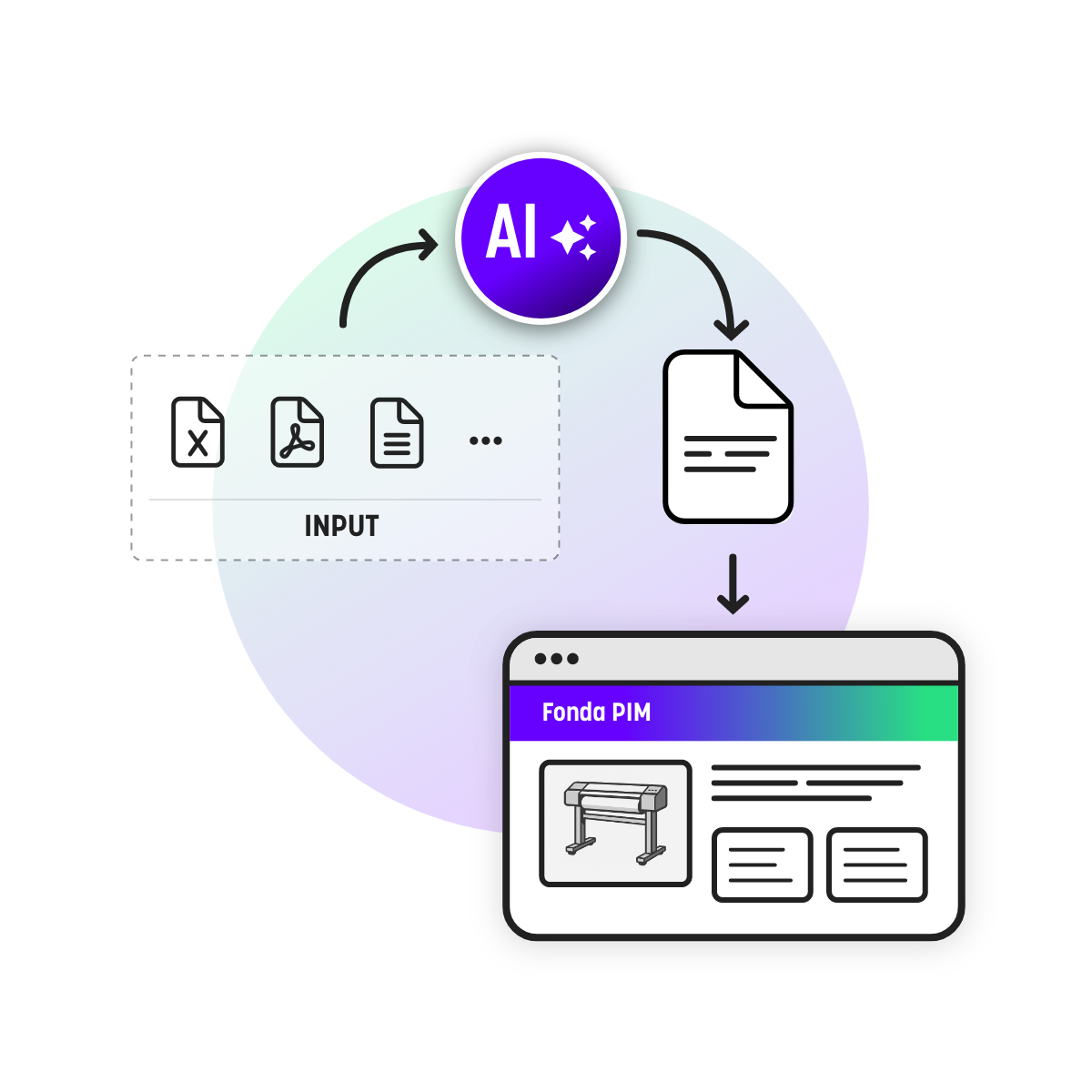
47,000 products with no description? AI will solve it before you know it.
The biggest waste of time with product data isn't managing it — it's creating it. Writing descriptions, adding specs, making translations: that's hours of work per product if you do it manually. Fonda's AI module does that automatically, based on what's already in your catalog.
What AI does for you in concrete terms
Generate product descriptions based on SKU, category, and existing specs — ready to validate, not start from scratch
Creating translations for Dutch, French, English or other markets — with one click, not with an external translation agency
Detect and complete missing fields — the system warns you when data is incomplete or contradictory before it becomes a complaint
SEO-optimized titles and meta descriptions suggest — so that your products are found, not just stored
AI vervangt je productteam niet.AI won't replace your product team. It takes over the repetitive work so that your team focuses on what matters: the right positioning, the right pricing strategy, the right channels.
You are convinced. Not your colleagues yet. Here are the arguments.
The biggest stumbling block with a new platform is rarely technology. It's the internal conversation: the manager who wants to see the budget, the IT department who wants to plan time, the colleague who asks why the current system isn't enough. Here are the three arguments that win that conversation.
Argument 1 — Zero risk of starting
Fonda Basic is free. No licensing fees, no implementation project, no IT ticket. You load in your product data, you see how it works, then you decide. There is no financial argument for not trying.
For your manager: “We'll try it for free. If it doesn't work, we won't lose anything except a few hours. '
Argument 2 — The cost of doing nothing
Every week that product data is distributed costs money. Manual input work, errors that lead to complaints, products that come online too late, markets you don't reach. This cost is difficult to quantify but is there every day.
For your manager: “How many hours does our team spend today synchronizing product data between systems? What is that per year? '
Argument 3 — It scales with no extra project
Fonda Basic is the beginning, not the end point. When you want to expand — more channels, more markets, link to your webshop or ERP — activate the modules you need. No new platform, no new migration.
For your IT department: “It's not a new implementation project. We start small and scale where necessary. '
Forward this page to your manager/decision maker. Or download our PIM checklist!
“Everything on the front end looks amazingly simple and structured for users. The feedback to the ERP is also perfectly arranged.”

Koen Van Der Chairs
Project Manager at Dupont Cheese (Milcobel)

PIM FAQ
These are the questions we hear the most from B2B companies considering a PIM system.
Fonda PIM is suitable for catalogues of tens of thousands of SKUs. The AI module is specifically designed to quickly enrich large catalogs without your team having to manually edit each product. Do you have a very large catalog (100,000+ SKUs) or exceptionally complex product structures? Then get in touch — we'll see what the best approach is together.
Yes. Fonda supports imports via Excel, CSV and directly from popular ERP systems such as Exact Online, SAP, Microsoft Dynamics and Odoo. You load your existing data via a structured import, Fonda normalizes the structure and the AI module detects missing fields. You don't have to start over.
The total turnaround time depends mainly on the size of your catalog and how much data is already available in a structured way. For large catalogues with a lot of missing data, the AI module significantly supports the enrichment process.
A PIM (Product Information Management) manages the textual and structural product data: descriptions, specifications, categories, translations. A DAM (Digital Asset Management) manages visual assets: photos, videos, technical drawings, PDF data sheets. Fonda combines both into one platform. You manage your product content and media from the same environment. At Fonda, you start with DAM for free.
Fonda's AI module does four concrete things: it generates product descriptions based on existing specs and category data, creates translations for multiple languages, detects missing or inconsistent fields in your catalog, and suggests SEO-optimized titles and metadata. Everything for validation — you decide what gets published, AI takes over the repetitive work.
Start with the basics.
Build from there.
Fonda Basic is free and immediately gives you a central place for all your product data and digital assets. You can take the step to a complete B2B webshop with customer-specific prices when you are ready.
Specifically built for B2B SMEs with 20–300 employees · Support based in Ghent